
Louisiana DPS&C Vermilion Custody
The Louisiana Department of Public Safety & Corrections is a statewide corrections system, not a separate prison proven to be inside Vermilion Parish. Research of the official facility directories found no distinct DPS&C prison in the parish. The system still matters locally because a person serving a state sentence can remain physically in a parish jail bed while DPS&C holds legal custody.
A VPSO current card may identify a “DOC PRISONER,” a holding status, or a detainer. If that card later disappears, do not assume community release. DPS&C may have reclassified or transported the person to another state or contract location. A new facility in Louisiana LAVNS supports transfer. A community-supervision status supports release from confinement with continuing legal control. Full discharge is a separate event.
Confirm a Louisiana DPS&C Release
Begin with a strong identity match. Use the DPS&C number when available. Otherwise use the exact name and date of birth, then compare the agency, location, and status. The official DPS&C inmate-information page directs users to LAVNS and explains the phone locator.
- Search Louisiana LAVNS by the most exact name or ID/case number available.
- Open the matching record and note the responsible agency, current status, location, and displayed update time.
- Call the DPS&C locator at 225-383-4580 with the DPS&C number or the name and date of birth.
- Ask whether the person is imprisoned, under probation or parole supervision, fully discharged, or outside DPS&C scope.
- Request the master prison record extract, release certificate, or supervision-discharge record when documentary proof is needed.
A missing online result is not proof of release. It may reflect data timing, spelling, scope, sealing, or a record that is no longer publicly retained. The phone locator and a focused record request are the documented fallbacks. The broader Vermilion Parish release search adds the county court and jail steps when the person also passed through VPCC.
Louisiana LAVNS Release Search
DPS&C uses Louisiana LAVNS at VINELink for imprisoned-person location and community-supervision information. The state says LAVNS is searchable by location, name, and ID/case number, covers people in prison and under probation or parole supervision, and updates every 24 hours. The public retention of fully discharged historical entries must be tested rather than promised.
Open the official Louisiana VINELink search and read only fields displayed in the matching result. The captured screen below shows the statewide entry point and search workflow.
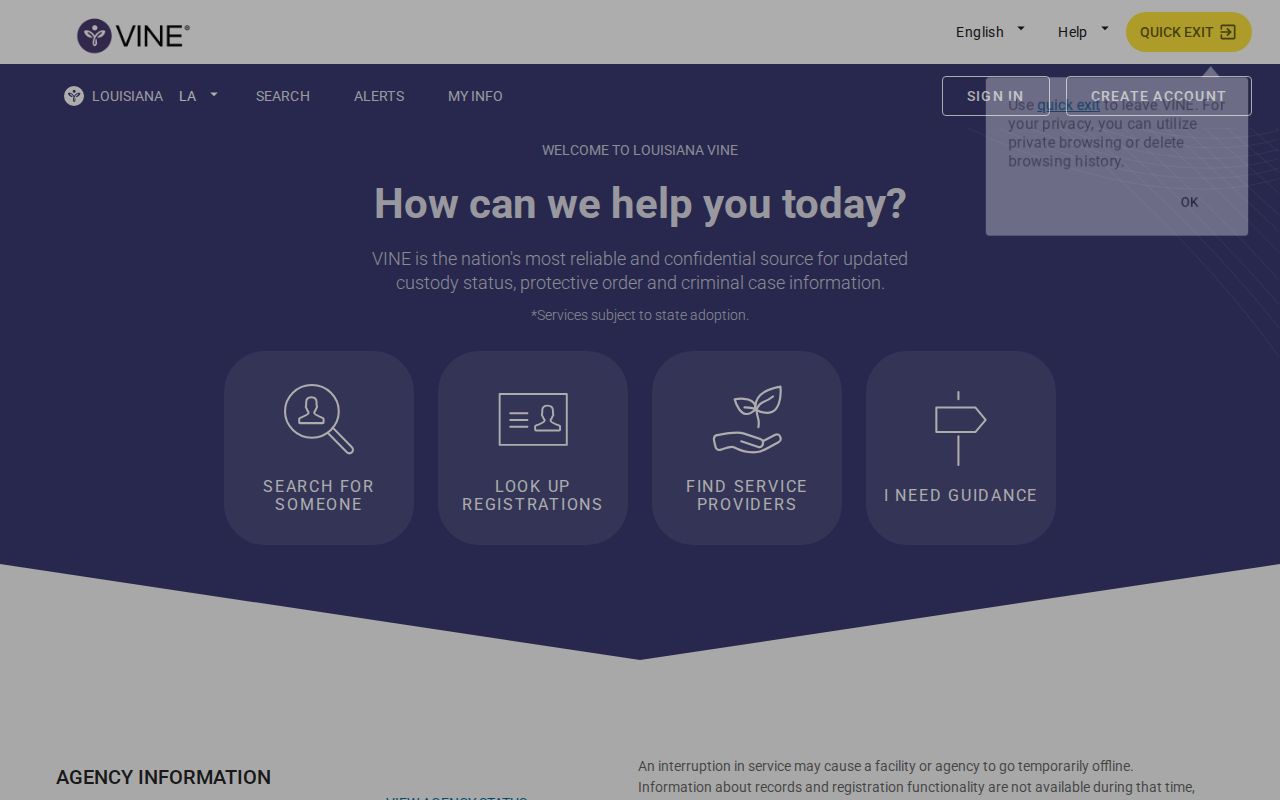
The screen provides a current lookup path, not a complete state release ledger. Status and event time should be saved and then checked against the custodian’s release record.
| Search item | How to use it |
|---|---|
| Name | Try exact and supported spelling variants, then compare identifiers. |
| ID or case number | Use it to reduce common-name errors and connect the right custody episode. |
| Responsible agency | Distinguish DPS&C, a parish jail, and community supervision. |
| Location | Treat a new facility as evidence of movement, not release into the community. |
| Status and update time | Record the exact displayed wording and when the system says it was current. |
| Notification option | Register for an offered release or transfer event, while keeping agency proof separate. |
Louisiana DPS&C Locator Contact
The telephone locator is the official fallback named by DPS&C. It can return the current confinement assignment, the assigned facility’s address and phone, and a “projected release date (if applicable).” That phrase matters. A projected date is a calculation and not proof that physical release occurred.
Louisiana DPS&C Offender LocatorPhone: 225-383-4580
Provide: DPS&C number, or name and date of birth
Scope: confinement assignment, facility contact, and projected release date if applicable
No single facility street address belongs in this system contact card because the page covers statewide legal custody, including people housed in a local bed. Use the facility address returned by the locator for the current placement. For records, use the current public or legal-record contact published by DPS&C rather than guessing an office address.
Note: Ask what date and status were current as of the call, then preserve the response with the person’s DPS&C identifier.
Louisiana DPS&C Release Dates
Four dates are often confused in a state sentence. A projected confinement release is a calculation based on the governing sentences and credits. First parole eligibility is only the first lawful chance for committee review. Actual physical release is the event when confinement ends. Supervision or full-term discharge is when the remaining legal term ends.
| Date or event | What it means | What proves it |
|---|---|---|
| Projected confinement release | A current estimate that can change. | DPS&C locator or computation record. |
| Parole eligibility | An opportunity for review, not a release promise. | Applicable law and official parole record. |
| Actual physical release | The end of confinement on the recorded date. | Release certificate or master prison record. |
| Community supervision | Parole or probation continues outside prison. | LAVNS and the responsible district. |
| Full discharge | The sentence or supervision term has ended. | DPS&C discharge record. |
A parole grant can still await an approved plan, resolution of a detainer, or another prerequisite. Likewise, a projected date can change because of sentence correction, jail credit, consecutive terms, disciplinary action, a new sentence, or credit loss and restoration.
Louisiana DPS&C Good-Time Records
Good time, formally called diminution of sentence, is earned credit that may reduce confinement for an eligible person. Louisiana R.S. 15:571.3 and R.S. 15:571.3.1 contain different rules tied to offense dates, offense types, exclusions, and conduct. For covered felony offenses committed on or after August 1, 2024, the newer provision permits up to fifteen percent diminution.
“Up to” is essential. It does not mean every person serves exactly 85 percent. Life terms, offenses without benefit, special categories, disciplinary forfeiture, and consecutive sentences can change or eliminate the calculation. Earlier offenses remain under the law that applies to them. Obtain the DPS&C computation instead of adding a percentage to a sentence date.
Parole eligibility under R.S. 15:574.4 is another legal date. It cannot be substituted for the projected confinement date or actual release. The crime, offense date, sentence, prior record, and statutory exclusions control.
Louisiana Parole Is Not Discharge
The Louisiana Committee on Parole makes release decisions within the Board of Pardons and Committee on Parole structure. Its parole docket page posts hearing weeks, notices, agendas, and results. A grant records a committee decision. It is not the timestamp when a person walked out, and it is not full discharge.
Official result codes can include granted, denied, ineligible, removed, withdrew, and work release. Use the result linked to the correct DPS&C number and docket. Then check prerequisites, detainers, the later custody record, and community-supervision status. Revocation dockets can explain why a person who had been released returned to custody.
Parole continues a sentence in the community under conditions. Full-term discharge ends the sentence. Probation is a court-ordered community sentence and need not follow state imprisonment. These terms should not be used as synonyms.
Request Louisiana DPS&C Records
A focused state record request should identify the DPS&C number, facility or legal-custody dates, and the exact existing record sought. Useful records include the master prison record extract showing admission and release, a release certificate, calculation sheet or projected-date history, parole certificate, supervision-discharge record, and intake photograph.
Some master-record, risk, security, victim, medical, and supervision details may be exempt. Ask for the releasable portion and the statutory citation for anything withheld. Louisiana R.S. 44:1 defines public records broadly, while R.S. 44:31 supplies the access right subject to exceptions. Redaction can preserve access to nonexempt fields.
The proof chain should match the question. Current location belongs to LAVNS and the locator. How confinement ended belongs to the release certificate or master prison record. Whether all supervision ended belongs to the discharge record. Keep the DPS&C number, custody dates, status wording, and source access date with each response so later updates can be reconciled. Using the right record prevents a technically accurate status from being turned into the wrong conclusion.