
Lafayette District Supervision Role
The Lafayette District Office is part of the Louisiana DPS&C Division of Probation and Parole. Its official listing says it serves Acadia, Lafayette, and Vermilion parishes. The district’s role begins or continues when a person is serving a community-supervision term. It is not a detention facility and has no inmate roster or release gate.
That distinction changes the question. Vermilion Parish Correctional Center Booking answers whether someone is physically held in the parish jail. DPS&C and LAVNS answer whether the person is imprisoned or under state community supervision. The Lafayette District is the regional route for public supervision status and the appropriate reporting office, subject to the person’s actual residence and assignment.
Verify Lafayette District Supervision
Use the DPS&C number when possible. Otherwise search with the exact name and date of birth, then compare agency and status. Parish of conviction does not always equal parish of residence or reporting office, so the Lafayette District should not be assumed until the state record or office confirms the assignment.
- Search Louisiana LAVNS at VINELink by exact name or ID/case number.
- Open the matching record and distinguish incarceration from probation or parole supervision.
- Record the displayed responsible agency, status, location, and update time.
- Use the DPS&C directory to confirm that Lafayette is the assigned reporting district.
- Ask the district to verify only public status, office responsibility, and whether the term is active or discharged.
A missing LAVNS result does not prove the term ended. It can reflect spelling, timing, scope, or public-retention limits. For a full verification, preserve the release-from-confinement date, supervision type, effective date, responsible office, projected or full-term end date if public, any warrant or revocation status, and the final discharge record.
The Vermilion Parish parole and probation page places this district route within the larger statewide decision and supervision process.
Lafayette District Office Contact
The official DPS&C location page provides the regional office details and confirms its three-parish service area. Contact the office for public supervision-status routing and reporting-office questions. Do not ask it to certify a VPSO booking release that belongs to the jail custodian.
Open the official Lafayette Probation and Parole District listing to verify current contact information.
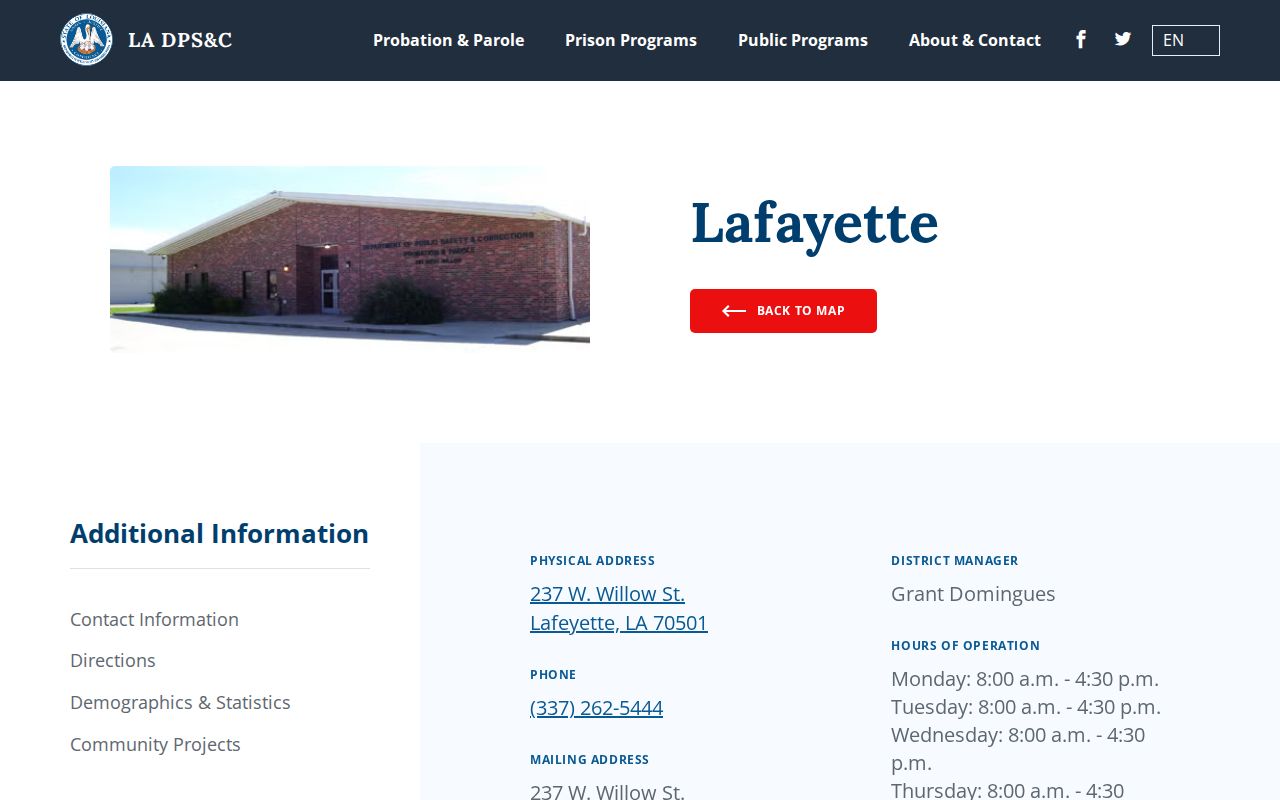
The capture documents the office that serves Vermilion Parish. It is a supervision-office source, not an inmate-release feed.
Lafayette District Office of Probation and Parole237 West Willow Street
Lafayette, LA 70501
Phone: 337-262-5444
Monday–Friday, 8:00 a.m.–4:30 p.m.
Individual reporting instructions control. A published office schedule does not change an officer’s direction, a court order, or a supervision certificate. Avoid publishing a person’s home address or details beyond what is needed to confirm the correct record.
Lafayette Probation Orientation Meetings
The Lafayette District describes monthly probation-orientation meetings where officers and a sentencing judge explain conditions and answer process questions. This is a specific regional feature for people beginning or serving probation. It provides context about how the office communicates supervision duties, but it is not a public roll of every person under supervision.
Probation conditions come from the court order and individual instructions. The meeting does not replace those documents. A person seeking the terms of a named case should start with the judgment, probation order, and any public supervision record. The district can clarify the reporting route within its lawful disclosure limits.
Monthly orientation should not be confused with monthly reporting. Statewide conditions and an officer’s directions can set reporting duties, and the person’s certificate controls. The office page supplies a local point of contact when a term or reporting location is unclear.
Note: Lafayette’s orientation program is a process resource, not proof that a named person is on probation or attended a meeting.
Lafayette Parole Versus Probation
Parole follows release from confinement and allows the remaining sentence to be served in the community under DPS&C supervision. Probation is imposed by a court, often with a suspended sentence, and may not follow a state-prison stay. Both are community statuses. Neither means the person is currently incarcerated at the Lafayette office.
| Status | How it begins | Best verification | How it ends |
|---|---|---|---|
| Parole | Release from confinement under a parole decision or applicable law | LAVNS, parole record, and assigned district | Discharge, revocation, or another official closing event |
| Probation | Court-ordered community sentence or suspended-sentence condition | Court order, LAVNS, and assigned district | Court or DPS&C discharge, revocation, or termination |
| Full discharge | Completion of the controlling sentence or supervision term | Official discharge record | No active term remains under that record |
A projected supervision end date is not the same as completed discharge. Verify the final status. A new court order, warrant, revocation, or sentence can change the path before the expected end.
Lafayette Supervision Release Records
The Lafayette District does not issue the physical release certificate for a prison or the booking-and-release record for VPCC. For a state-prison episode, DPS&C records can include the master prison record, release certificate, parole certificate, calculation history, and later supervision-discharge record. For probation, the court judgment and probation order establish the legal term.
A complete post-release record should distinguish several events: release from confinement, the beginning of supervision, the responsible office, any change in status, and final discharge. If VPSO also held the person, the county record shows only how that parish booking ended. It cannot by itself prove that every DPS&C sentence or supervision term ended.
- Release from confinement
- The physical end of prison or jail custody, which can start parole.
- Effective supervision date
- The date probation or parole responsibility begins under the controlling record.
- Revocation
- An official process that can end community status and return a person to custody.
- Discharge
- The confirmed completion of the sentence or supervision term.
When records are requested, identify the DPS&C number, supervision type, approximate dates, and specific document. Ask for the releasable portion and a statutory citation for withheld material. Supervision details involving protected people, risk, security, medical facts, or other exceptions may be restricted.
Lafayette Warrants and Revocation
An absconder is a person alleged to have stopped reporting or otherwise failed to remain in contact as required. The label may lead to a supervision warrant. A warrant is not proof that the person has already been arrested or returned to custody. No dedicated Vermilion Parish absconder list was found in the reviewed VPSO prisoner interface.
Use official law-enforcement or DPS&C information to confirm an active warrant. If a parole warrant is executed, preliminary-hearing rights and a revocation process can follow. The Louisiana Committee on Parole generally decides at the end of the parole-revocation proceeding. Official revocation schedules and results can explain why someone who once appeared in community supervision is again confined.
The DPS&C revocation docket page says its pages are updated at noon Monday through Friday and are subject to change. A schedule is not a final decision. Match the DPS&C number and later result, then confirm custody through the state system.
Lafayette Parole Decision Limits
Louisiana’s Committee on Parole, not the Lafayette District office, makes parole decisions. The committee publishes hearing weeks, notices, agendas, and results. Its overview says hearings are usually scheduled within nine months of eligibility, but that schedule does not promise release.
A grant can await an approved plan, detainer resolution, or other prerequisite. The later DPS&C custody record establishes actual physical release. Once released to the Lafayette District, the person remains under supervision until a discharge or other official closing event. Eligibility, decision, release, supervision, and discharge must remain separate.
Parole eligibility depends on offense date, offense type, sentence, prior record, and statutory exclusions under Louisiana law. It should not be calculated from a general fraction. Use the official record for the named sentence and preserve the committee result with the state custody status.
Lafayette and Vermilion Record Roles
The best record depends on the question. Current presence in VPCC belongs to VPSO Booking and the current roster. The reason a Vermilion Parish booking ended belongs to the VPSO release or transfer entry plus the court or receiving agency. Active community supervision and final discharge belong to DPS&C and the responsible district.
| Question | Correct source |
|---|---|
| Is the person physically in VPCC now? | VPSO Booking and current roster |
| Did the VPSO stay end by release or transfer? | VPSO booking-and-release record |
| Is the person on probation or parole? | LAVNS, court or parole record, and assigned DPS&C district |
| Does Lafayette supervise the person? | State record and Lafayette District confirmation |
| Has the full term ended? | DPS&C or court discharge record |
The Vermilion Parish release-record path joins these sources without treating one system as a substitute for another. It also keeps federal and immigration custody separate when a transfer leaves the state corrections framework.